Coffee is an annual crop, and almost everything a buyer wants to know is a function of where in the year a lot comes from. Knowing the local calendar tells you whether the coffee in front of you is fresh, what it should taste like, and why a particular roast was available in March but not in June.
The Kilimanjaro coffee year, roughly
These are typical windows for the southern slopes of Kilimanjaro and the Moshi area. Every one of them moves with altitude, with how the rains arrive, and with the individual farm.
March to May — the long rains and the main flowering
The long rains trigger flowering. White blossom appears, and the cherries set during this window are the ones that will be picked later in the year. A poor or badly timed long rains season shows up in the harvest six months later, not immediately.
June to July — cherry development
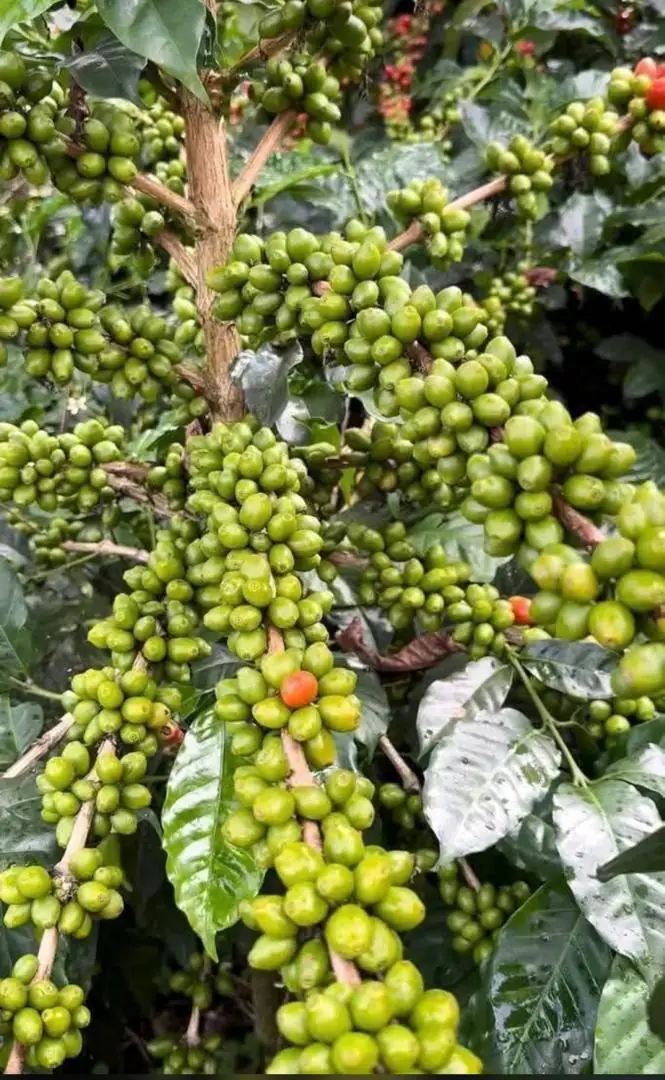
The dry season begins. Cherries expand and begin to fill. Still green, still hard. Earliest lots on the lowest farms may just begin to turn.
August to November — the main harvest
The main picking period. Cherries ripen unevenly across a single tree, so a farm is picked in several passes rather than once, usually a week or two apart, taking only the fully red cherries each time. Higher farms ripen later than lower ones, so the harvest moves up the mountain as the months pass.
October to December — short rains and late lots
The short rains overlap the end of the harvest. For anything still on the drying beds this is the difficult part of the year: drying is slower, cover matters, and lots need more attention to reach a safe moisture content.
December to February — milling and preparation
Dried parchment coffee is rested, then hulled, graded and sorted at the dry mill, and prepared as green coffee for roasting or export. This is when a harvest becomes lots with identities and grades attached.
Why altitude moves the date
Cooler air slows ripening, so the same variety planted higher up is picked later. On a mountain with farms spread across hundreds of metres of elevation, that can mean several weeks between the bottom and the top of the growing band. It is the same mechanism that gives high-grown coffee its density and acidity — explained at more length in what altitude does to a coffee bean.
Selective picking against strip picking
Because ripening is uneven, there are two ways to harvest. Selective picking means repeated passes taking only ripe red cherries; it costs far more in labour and is the reason a specialty lot can be consistent. Strip picking takes everything on the branch in one pass — faster and cheaper, and it mixes unripe, ripe and overripe fruit into the same lot, which no amount of later care fully corrects.
This is the first quality decision in the whole chain, and it happens before any equipment is involved.
What “current crop” means to a buyer
Green coffee does not keep indefinitely, even well stored. Fresh-crop coffee cups brighter and sweeter. As a lot ages past a year it flattens, and can take on woody, papery or baggy characteristics that no roast profile recovers.
So when a seller says “current crop”, the useful follow-up is: which month was it picked? That is a fact rather than a category, and it is one of the questions on our list of what to ask before buying green coffee.
Why availability changes through the year
Roast profiles, pack sizes and green-coffee lots are not fixed inventory — they follow the harvest and what remains in store. That is the practical reason nothing on this site is published as a permanent price or a permanent stock list: it would be wrong within a season.
For what is available now, start an enquiry through the marketplace or contact the team, and they will confirm current roasts, formats and quantities.
Questions we get asked
Can I buy Rocky Coffee all year round?
Roasted coffee is sold through the year, but which profiles, formats and quantities are available changes with the harvest and with what remains in store. Send an enquiry and the team will confirm what is currently available.
When is the best time of year to visit?
The main picking period, roughly August to November, is when there is most to see on the farms and at the wet mill. Visits are arranged in advance either way, so contact the team with your dates and they will tell you what stage the season is at.
Does northern Tanzania have a second coffee crop?
Northern Tanzania is primarily a single main-crop region, with flowering driven by the long rains and picking concentrated in the second half of the year. Timing shifts year to year with the rains rather than splitting into two separate harvests.